 Sly Arcade
Killer Sudoku
Use cage totals and no-repeat rules to find the missing digits.
Help
Select a cell · 1–9 fill · N notes · arrows move · Delete erase · Ctrl/Cmd Z undo. Use the game’s menu for sound and save tools.
Sound
Progress stays in this browser. Export in the game before clearing browser data.
Your first move: Select an empty cell, then choose a digit or switch Notes on.
After a level: replay & next steps
Try the next puzzle, or use notes and explained hints to explore a new approach. Your own pace is the right pace.
How to play & controls
Use ordinary Sudoku units. Every connected cage has the indicated total and contains no repeated digits.
- Select an empty cell, then choose a digit or switch Notes on.
- Ask for a gentle hint: attention first, proof next, then the conclusion only when you request it.
- Undo uncertain moves or pause. Every puzzle is open; daily selections use a separate save.
Select a cell · 1–9 fill · N notes · arrows move · Delete erase · Ctrl/Cmd Z undo
Tips & saving
A two-cell cage totaling 3 contains 1 and 2, in some order. A cage totaling 10 does not make every sum-to-10 pair available: any digit excluded by a row, column or box is unavailable in that cell.
The cage assistant shows ordered compatible sequences using the current board. Its cell order is explicit. Filled digits count toward the target, and repeated cage digits are rejected.
A complete row, column or box totals 45. If fully enclosed cages account for 36, the remaining cells sum to 9. This arithmetic becomes useful only after checking which cages are wholly inside the unit.
Game progress belongs to this browser and this address. Use the game’s own save tools where available. Changing addresses or clearing browser data does not transfer your save.
Read the guideHow to play Killer Sudoku
Killer Sudoku keeps every classic rule: each row, column and 3×3 box holds the digits 1 to 9 once. On top of that, dashed outlines called cages cover the grid. Every cell belongs to exactly one cage, and the small number in a cage’s corner is the total of its cells. In this collection a cage has 1 to 4 cells, and a puzzle has 27–38 cages.
Killer Sudoku cage rules
- The digits in a cage must add up exactly to the number in its corner.
- A digit cannot repeat inside a cage, even when the cage spans two boxes.
- Two different cages can hold the same digit, as long as the row, column and box rules still allow it.
- Unlike many Killer Sudoku books, these puzzles also start with some given digits: 18 in most puzzles, more in the first stage. The givens alone never finish the grid; you need the cages.
How the 200 Killer Sudoku puzzles are graded
The puzzles come in 6 stages, from many givens and short cage sums to longer chains of arithmetic. The score is the difficulty rating from the logical solve that checked each puzzle: every step adds the square of its technique’s weight, so longer solves and heavier techniques score higher.
| Stage | Puzzles | Givens | Cages | Score |
|---|---|---|---|---|
| Getting started | 1–20 (20) | 29–43 | 29–36 | 234–545 |
| Fluency | 21–60 (40) | 18 | 28–37 | 604–758 |
| Combinations | 61–110 (50) | 18 | 28–36 | 760–822 |
| Reasoning | 111–150 (40) | 18 | 28–37 | 822–856 |
| Challenge | 151–180 (30) | 18 | 27–36 | 888–1038 |
| Collection finale | 181–200 (20) | 18 | 28–38 | 856–881 |
Getting started gives you 29–43 digits, so most cages already have a cell filled. From Fluency on, every puzzle starts with 18 givens and the cages do the rest. Challenge holds the highest scores (888–1038); Collection finale is a closing set at a steadier level. No puzzle needs pairs, triples or an X-wing: the heaviest step anywhere in this Killer Sudoku set is the rule of 45 or a locked candidate.
The rule of 45 in Killer Sudoku
Every row, column and box contains 1 to 9 once, so it always totals 45. When the cages lying completely inside a unit leave one cell uncovered, that cell is 45 minus their totals. This is called an innie. When the cages that touch a unit cover it plus one cell outside, that outside cell is their total minus 45: an outie. If two cells are left, you learn their sum, and the cage rules or the candidates usually split it. Check that a cage is wholly inside the unit before counting it; a cage that crosses the border does not belong in the sum.
Worked Killer Sudoku examples, one per stage
Each example is the opening board of a real puzzle in this collection, and each conclusion matches that puzzle’s unique solution. Cells are named by row and column: r3c6 is row 3, column 6.
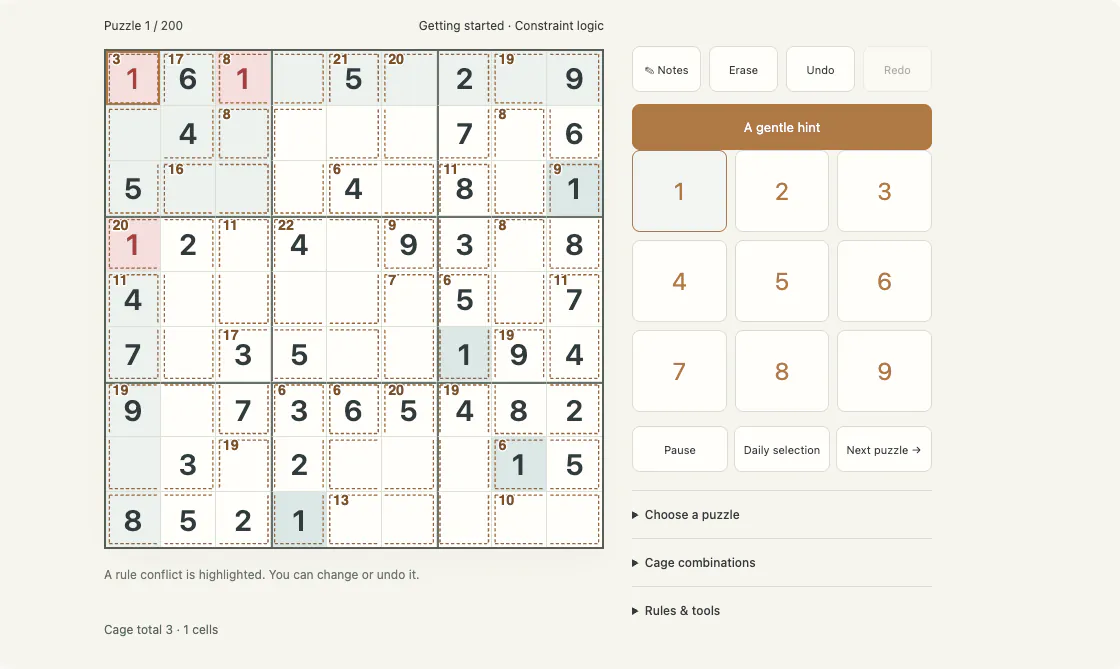
Killer Sudoku 1 (Getting started): a cage with one given
The cage r3c5 and r3c6 totals 6. r3c5 is already 4, so r3c6 must be 6 − 4 = 2. Early Killer Sudoku boards are full of these one-step cages; fill them first.
Killer Sudoku 22 (Fluency): a sum with only one pair
Two different digits can make 17 only as 8 + 9. The cage r4c7 and r4c6 therefore holds 8 and 9. r6c5 is a given 9 in the same box as r4c6, so r4c6 cannot be 9: it is 8, and r4c7 is 9. Learn the one-way sums: 3, 4, 16 and 17 for two cells; 6, 7, 23 and 24 for three; 10, 11, 29 and 30 for four.
Killer Sudoku 61 (Combinations): a cage set meets the candidates
Four different digits total 10 only as 1, 2, 3 and 4, so the cage r4c1, r3c1, r2c1 and r1c1 contains exactly those digits. r2c1 is a given 1, which leaves 2, 3 and 4 for the other three cells. Box 1 already has a 2, so neither r3c1 and r1c1 can take it. The 2 of this cage must be r4c1.
Killer Sudoku 111 (Reasoning): an innie
In box 4, 3 cages sit completely inside the box: 16 (r6c1, r6c2, r6c3), 15 (r5c2, r4c2, r4c3) and 9 (r4c1, r5c1). Together they total 40 and cover every cell but r5c3. The box totals 45, so r5c3 = 45 − 40 = 5.
Killer Sudoku 151 (Challenge): an outie
The cages that touch column 9 are 13 (r1c9, r2c9), 16 (r9c8, r9c9, r8c9, r7c9), 11 (r5c9, r6c9, r5c8) and 8 (r3c9, r4c9). They total 48: the column’s 45 plus two cells outside it. One of those, r9c8, is a given 2. So r5c8 = 48 − 45 − 2 = 1.
Killer Sudoku 182 (Collection finale): the rule of 45 leaves a pair
In column 7, the cages wholly inside the column total 36, so r3c7 + r6c7 = 45 − 36 = 9. The pairs for 9 are 1+8, 2+7, 3+6 and 4+5. From the givens, r3c7 can be 1, 2, 4 and 5 and r6c7 can be 1, 2 and 5. Only 4 + 5 fits both, with 4 at r3c7, because r6c7 cannot be 4. So r3c7 is 4 and r6c7 is 5.
Killer Sudoku vs classic Sudoku
- What it adds: cage totals and the no-repeat rule inside each cage. Most progress comes from arithmetic: which digit sets can make a total, and what the rule of 45 says about a unit.
- What it takes away: givens. Our classic Sudoku puzzles start with 22–43 digits; Killer Sudoku from Fluency on starts with 18, and those alone cannot solve it.
- What stays the same: rows, columns and boxes, notes, and the scanning habits from classic Sudoku. Once the cages narrow a cell, the same singles you use in classic Sudoku place the digit.
Killer Sudoku FAQ
Can a digit repeat in a Killer Sudoku cage?
No. Each cage holds different digits. A 2-cell cage of 4 is 1 + 3, never 2 + 2.
How do you know each Killer Sudoku has one solution?
An independent solution counter checked every puzzle in this collection and found exactly one solution. The puzzles are original, generated for this collection.
Can every Killer Sudoku here be solved with logic alone?
Yes. A puzzle was kept only when a step-by-step logical solve could finish it without guessing, and that solve is also where the difficulty score comes from.
What should I do when a Killer Sudoku gets stuck?
Ask for a hint: it first shows where to look, then the proof, then the digit only if you ask. The cage assistant lists the digit sequences that still fit a cage on your current board. You can also write notes, undo, or read the cage sums guide.